

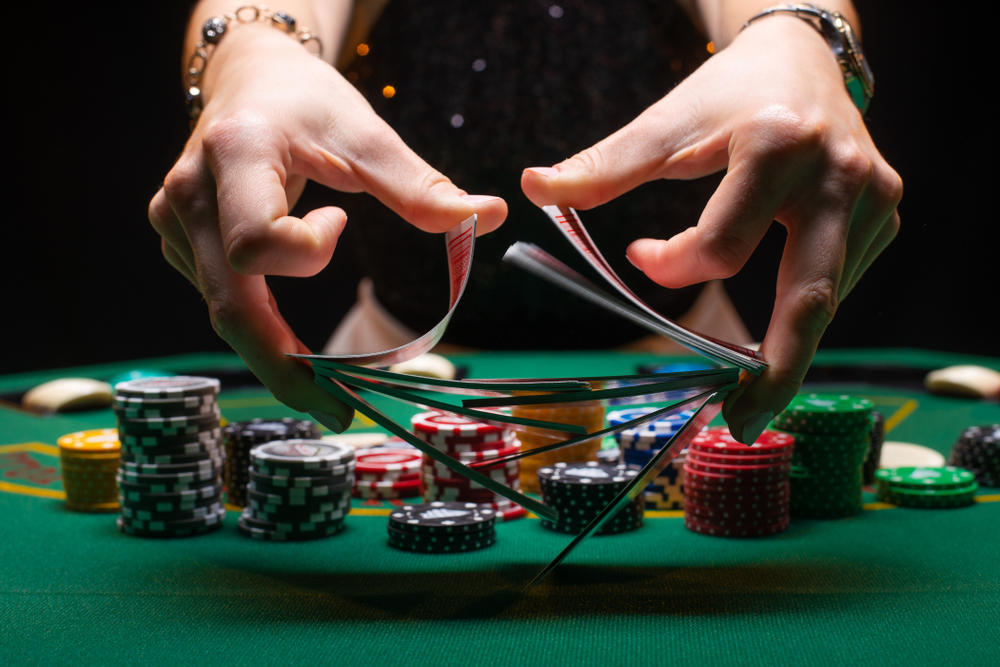
Everything can change in a good card game through the dealer’s shuffle.
In a matter of seconds, right after the expectation created by their movements, luck either appears or disappears, adrenaline increases, and strategy often needs to be redefined.
This is such an act closely connected to card games and so striking across different formats that even online casinos, such as Betsafe Casino, have brought dealers into their digital platforms.
However, have you ever stopped to think about how and when the shuffle became an indispensable element in most casino games?
Perhaps you will discover this and other information on the topic in today’s article.
The birth of playing cards in history
The earliest records of playing cards and card games appeared in China in the 9th century. At that time, decks did not yet have a standard format. Due to communication difficulties, different rules naturally developed across different regions.
In this context, shuffling was much simpler and far less technical than it is today. The idea of perfect randomness was not yet the main focus, but it was still important for a certain level of fairness to be introduced through the cards.
Why is shuffling essential in card games
The factor of randomness is essential in any card game. It can be said to dictate the pace across different formats, ensuring that each round begins from a neutral point where no player has a prior advantage.
To illustrate its importance, shuffling is not just a formality, but a process deeply studied within mathematics.
The mathematical rule behind seven shuffles
In 1992, American mathematicians Persi Diaconis and Dave Bayer demonstrated that in a standard 52-card deck, seven riffle shuffles were sufficient to achieve an ideal level of randomness.
The study showed that fewer shuffles could leave visible patterns, whilst additional shuffles made little meaningful difference. Therefore, what was once thought to be repetition as the key factor was challenged by the findings of the mathematicians, changing long-held assumptions.
What is the riffle shuffle?
The riffle shuffle is one of the most famous types of shuffling in the world. It is characterised by splitting the deck into two halves, which are then interwoven, allowing for a near-perfect mixture of the cards, while also maintaining a natural flow that resembles how decks are handled in real gameplay situations.
It was largely due to the revelation made by Persi and Dave that major casinos in large centres such as Las Vegas began adopting seven as the standard number of shuffles, as a way to ensure fairness in the game.
This is why you are almost certain to have seen it performed before, whether in a card game, in a casino environment, or at least in a film or television production where gambling scenes are portrayed.
Early methods of card shuffling
Although the riffle shuffle was widely adopted as the ideal technique for ensuring randomness in card games in 1992, this type of shuffle had already been mentioned in the book Expert at the Card Table by S W Erdnase in 1902.
In other words, not only this method but many other popular techniques, such as the overhand shuffle and the faro shuffle, may have existed for hundreds of years. After all, the modern 52-card deck format began to be used in the 15th century.
The rise of the dealer’s signature shuffle
The fact is that card games have grown significantly over time and have become increasingly structured, formalised, and regulated activities across different regions and casino environments.
In the second half of the 20th century, it became essential to ensure the integrity of games at a higher professional level. From that point onwards, dealers began following standardised shuffling procedures combining different techniques, which is now commonly referred to as the signature shuffle.
These procedures were not only designed for fairness but also for consistency across tables, ensuring that every game followed the same level of procedural control regardless of location or dealer experience.
The visual impact of the dealer’s shuffle
To perform shuffling movements, a great deal of skill is required. And just as it is often impressive to watch someone performing something that demands knowledge and practice, the visual aspect is also often a show in itself when it comes to dealers.
Within the strict standards required by major casinos, each dealer develops their own rhythm, which makes the shuffle more distinctive overall.
This combination of factors not only affects players through the professionalism with which the game is conducted, but also spectators, as the movements become part of the overall casino atmosphere.
Technology in shuffling
Due to advancements in monitoring and the need to guarantee fair play, technology began to enter casinos at the end of the last century and even replaced some dealer functions.
Despite all the skill and ability demonstrated by dealers, automatic shuffling machines were designed to mix cards in a continuous and standardised way, significantly reducing the risk of human error.
In addition, the aim was to bring even more pace to games that require a faster rhythm, such as blackjack, for example.
How online casinos replicate the shuffle
Technology has also brought about the rise of online casinos as we know them today.
However, just as some casinos maintain dealers and traditional shuffling systems in their physical spaces, many digital casinos also feature a dealer performing shuffles on the other side of the screen.
The role of dealers in the online casino experience
There are several reasons for this. Firstly, the dealer is part of the casino’s aesthetic, and the shuffle is present in many games, helping to transfer the physical casino experience into the online environment.
In addition, players tend to trust randomness more confidently when they see a trained professional carrying out the process.
Fairness in digital games without dealers
Many online games do not operate with dealers and do not even use physical cards. On many betting platforms, poker is one of them. In this case, randomness is ensured by an RNG (Random Number Generator).
The reliability of these systems is often verified by independent testing agencies such as eCOGRA, which certify fairness and compliance in online gaming platforms.
This demonstrates how technology has an impact, but the core idea of fairness remains consistent in both physical and digital environments.
