

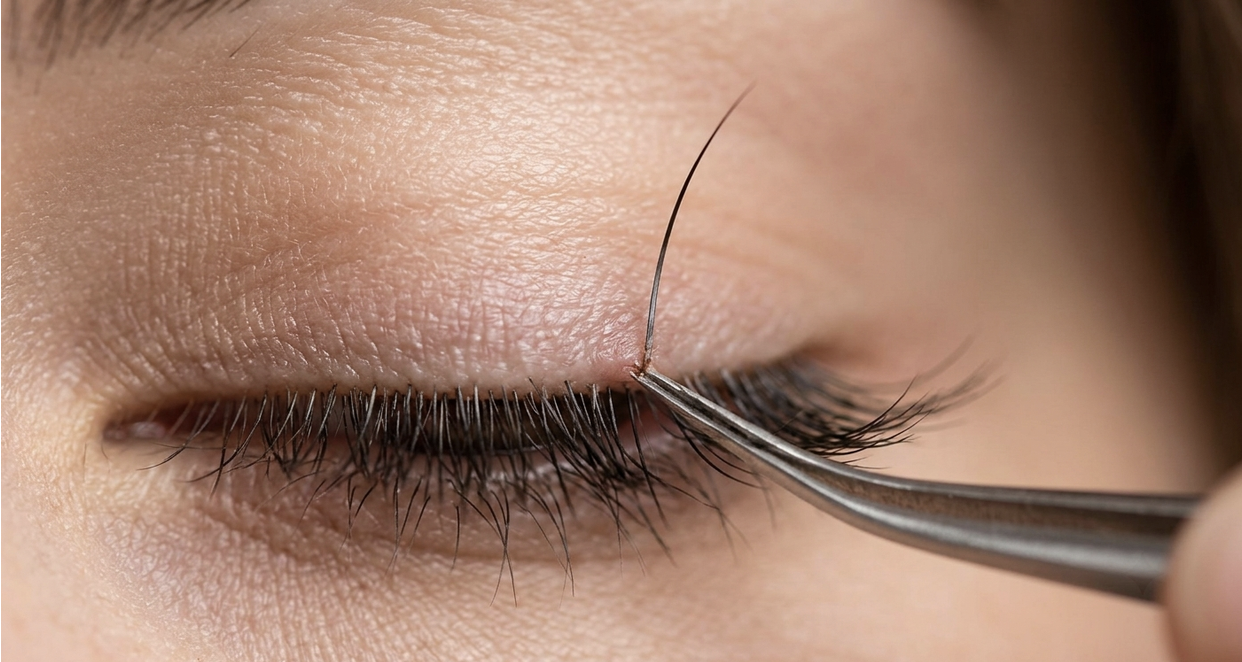
One tug with tweezers and the extension comes away with your own lash, pulled out at the root. A new lash takes six to sixteen weeks to grow back, leaving a visible gap along your lash line. The reason is mechanical: the glue holds the two lashes together more firmly than your natural lash is anchored in the skin.
Extensions can come off without a single tug. A professional lash remover is a solvent that breaks the adhesive down chemically, so the extension lifts away on its own. Here is what really happens at home, and how to do it properly.
What Happens When You Pull on an Extension
Start with the anatomy. A natural lash sits only about two millimetres deep in the skin, and unlike the hair on your head, it has no tiny muscle to hold it at an angle. It is rooted more shallowly than it feels. On top sits an extension, longer and heavier, fixed with cyanoacrylate glue, the base of most professional lash adhesives.
Pull on that extension and the force runs through the bond straight to the root of your own lash. It is the principle behind the dermatological hair pull test: a hair in active growth is firmly anchored and will not budge under gentle tension. So a sharp movement yanks the lash out at the root, sometimes with a neighbour or two, rather than releasing the bond.
The Lash Growth Cycle and Why Thinning Shows
Lashes renew slowly. Every hair moves through three phases: active growth (anagen) runs about 8 to 10 weeks, a short transition (catagen) about two weeks, and a resting phase (telogen) over several months before the lash sheds. At about 0.15 mm a day, a lash needs weeks to reach full length.
A pulled-out lash does not bounce back fast. Regrowth takes weeks, and the lash line can need up to three months to return to its former density. Since each neighbouring lash sits at a different point in its cycle, one gap stands out sharply and fills in unevenly.
When Lashes Might Not Grow Back at All
A one-off incident is usually reversible as the follicle recovers. Repeated trauma is the real concern. Constant pulling even has a medical name, traction alopecia, hair loss from chronic tension. It is a recognised complication of lash extensions, and the American Academy of Ophthalmology notes that rubbing, tugging and pulling can break natural lashes and damage the follicle, sometimes for good.
Risks That Go Beyond Your Lashes
The eyelid skin is thin and the eye surface sensitive, so rough force costs you more than a few lashes:
- Damage to the lid and eye surface. Ophthalmologists link the pressure of careless removal to subconjunctival haemorrhage, the red patch on the white of the eye.
- Infection. A tug leaves tiny tears, and bacteria from your fingers or tweezers reach the skin along the lash line. In a review of documented lash-extension complications, the most common was allergic blepharitis (inflammation of the eyelid margin), found in about 79% of reported cases.
Dissolving the glue with whatever is in the bathroom cabinet is its own hazard. Here is what people reach for, and how it goes:
| Method | Dissolves the glue? | Why it is risky |
|---|---|---|
| Acetone or nail polish remover | Unreliably | Poison control experts warn against acetone near the eyes or mucous membranes. The thin eyelid skin can suffer a chemical burn |
| A cotton pad against the glue | No | Cyanoacrylate can react with cotton, an exothermic reaction that releases heat and risks a burn |
| Oil, steam or micellar water | No | These do not dissolve the glue. The extension only loosens partway and clings on more weakly, making it easier to catch and tear out |
How to Remove Extensions Without Damage
There are two safe routes, neither with a single tug.
The first is to let them shed naturally. An extension stays put only as long as the natural lash beneath it. When that lash sheds, the extension goes with it, and a full set clears on its own in roughly 4 to 8 weeks without infills.
The second is a professional removal. A technician covers the lower lid with protective pads, applies a cream or gel remover along the lash line, leaves it for 5 to 10 minutes, then brushes the softened extensions away with a soft spoolie. No pulling. The whole appointment takes 15 to 30 minutes. In the UK a standalone removal runs roughly £5 to £35, and many salons include it free or discounted with a new set, so safety comes cheap.
Why does the remover belong in the salon and not at your bathroom sink? It is a professional solvent, labelled as an eye irritant and marked for professional use only. A technician applies it with a micro-brush, controlling every drop. Do it yourself, and the solvent can easily reach your eye. A patch test is standard before a first appointment: a tolerance check 24 to 48 hours ahead, to see how your skin reacts.
If your extensions bother you, do not pull or pick at them. Let them shed, or book in with a technician. Your own lash takes months to grow back; a professional removal takes half an hour.
When to See a Doctor
Sometimes the problem goes beyond looks. Severe or lingering pain, spreading redness, a swollen lid, discharge or any change in vision, after the extensions or after removing them, is a reason to see an eye doctor. Home methods only make it worse. And if you spot signs of an allergic reaction, do not take the extensions off yourself: ophthalmologists warn it can injure the eye further, so see a specialist straight away.
Every extension rests on a living lash with its own renewal cycle, which is exactly why removal has to be gentle. Half an hour of patience, or a quick appointment, almost always costs less than the months a pulled-out lash needs to grow back.
